Forensic Biology Option at Laurentian University.
December 08, 2003
Article contributed by
Scott I. Fairgrieve, Ph.D., Associate Professor
and
Tracy S. Oost, Curator, Forensic Osteology Laboratory.
Since 1998 Laurentian University’s Department of Biology has offered a
Forensic Biology Option within its 4-year honors Bachelor of Science in Biology. The strength of offering such a
program is that we believe that it is essential to produce scientists first, and then to supplement that training
with exposure to forensic applications. To that end, our graduates are positioned to go on for further training
at the graduate level in areas such as histology/pathology, entomology, botany, and biochemistry, among others.
Graduates also have all of the requirements for medical school, law school, dental school, and other professional
programs. For the student that would like to enter the job market the degree provides the training necessary
for employment in a forensic or biomedical laboratory setting, or policing.
Program Entrance Requirements:
All students wishing to be considered for the Forensic Biology Option apply through the
Ontario Universities Application Centre (OUAC) using the code “LRA”. High school students applying for
first year entry into the Forensic Biology Option are required to have a minimum 85% average across
their six best “U” or “M” level courses (including English and at least two sciences and one mathematics,
or one science and two mathematics courses) from grade 12. We highly recommend that they take grade 12
biology, chemistry physics and calculus. Based on ranking these students, the top 20 are offered direct
entry to the first year. Those who do not get into the Forensic Biology Option in first year, or who
do not have the minimum 85% to apply for first year entry may attend Laurentian and complete a prescribed
series of first year courses with a minimum overall average of 70% (no failures), then apply for entry into
the second year of the Forensic Biology Option. Again, the students are ranked and the top 10 are admitted.
This results in a second year cohort of 30 students. Keeping class sizes small allows us to have a very
hands-on approach in the learning environment.
Program Details:
In addition to courses in human anatomy and physiology, organic and
biochemistry, and even ecology, our students have their first exposure to forensic
science via the second year full course in Forensic Biology. This course, open only
to Forensic Biology students, surveys the broad fields affiliated with forensic biology
through lectures and laboratory sessions.
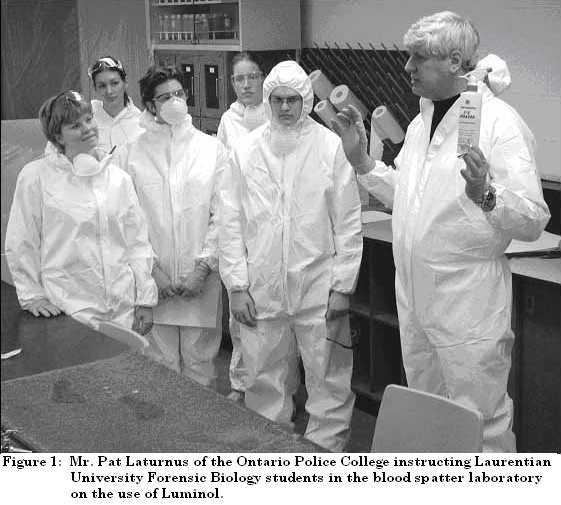 These laboratory sessions are not designed
to mimic the training undertaken by forensic identification officers at the Ontario Police
College or Canadian Police College (something best left to those agencies), but do undertake
to train students in the analytical methods and protocols undertaken in various types of
biological analyses. These laboratory sessions provide students with a means of conducting
an analysis of various biological specimens, and then relating their findings to various
forensic scenarios. These sessions are enhanced by the participation of various experts
in their respective fields. For example, in cooperation with the Forensic Identification
Training Branch of the Ontario Police College (OPC), Mr. Patrick Laturnus, their lead
instructor in the area of blood spatter interpretation, conducts a laboratory with our
students in this area (Figure 1). Characteristics of the aerodynamic properties of blood
and the various means of quantifying spatter patterns as a means of interpreting a sequence
of events is stressed in this lab. This philosophy of “learn by doing” underpins our approach
to instructing students in the application of scientific analysis to legal contexts.
These laboratory sessions are not designed
to mimic the training undertaken by forensic identification officers at the Ontario Police
College or Canadian Police College (something best left to those agencies), but do undertake
to train students in the analytical methods and protocols undertaken in various types of
biological analyses. These laboratory sessions provide students with a means of conducting
an analysis of various biological specimens, and then relating their findings to various
forensic scenarios. These sessions are enhanced by the participation of various experts
in their respective fields. For example, in cooperation with the Forensic Identification
Training Branch of the Ontario Police College (OPC), Mr. Patrick Laturnus, their lead
instructor in the area of blood spatter interpretation, conducts a laboratory with our
students in this area (Figure 1). Characteristics of the aerodynamic properties of blood
and the various means of quantifying spatter patterns as a means of interpreting a sequence
of events is stressed in this lab. This philosophy of “learn by doing” underpins our approach
to instructing students in the application of scientific analysis to legal contexts.
Although we recognize that we are training students to be scientists, it is also
incumbent upon us to enhance that training with courses from our Department of Law
and Justice. This provides students with a context of where scientific
evidence, and the scientists themselves, fit into our legal system.
Students also have a variety of opportunities to enhance their training further via thesis
research or a Forensic Biology Internship. The thesis research conducted by our students
has ranged from dental aging techniques and decomposition standards to volume determination
from blood spatter patterns. As part of the ongoing support for this research the Forensic
Osteology Laboratory in cooperation with the Ontario Police College in Aylmer Ontario, has
established a dedicated decomposition facility. Pig carcasses are placed in various contexts
in order to quantify the rates of decomposition. Physical stages, insect succession and even
biomass variations in the context of the environment of southern Ontario have been studied.
This long term arrangement with OPC is allowing our students to participate in establishing
standards for decomposition in Ontario. The results of these various studies are
presented each year at the Toronto Police Forensic Identification Conference.
Forensic Biology Internships are designed especially for those students that are
contemplating going into policing or laboratory technology. Internship students have
undertaken placements with the Ontario Provincial Police in North Bay, Sault Ste. Marie,
South Porcupine, and with the Greater Sudbury Police Service. Most recently the scope of
these internships has become international with the Royal St. Lucia Police Force hosting a
student from that island who would like to work with their force in the future. The significance
of this internship was that the student was participating in the establishment and expansion of a
forensic unit in this police service. The internships involve students in an applied research
project that is requested by the host institution. It should be stressed that not all of our
students undertake an internship. We match the best of our students with a
host agency that feels it will benefit a student according to their career goals.
Forensic Faculty and Staff:
Forensic Biology Faculty and Staff at Laurentian are practicing forensic scientists.
In addition to their regular academic teaching duties they also consult in a variety of legal
cases for police services and the Office of the Chief Coroner of Ontario. They are also actively
involved in a partnership with the Ontario Police College, providing both research and learning
opportunities for students and law enforcement personnel. Some of the projects they are involved
in include:
- Identification of previously unidentified Titanic victims
- Research in decompositional rates for Ontario
- Research in forensic entomology for Ontario
- Research in cremation scenes
Life at Laurentian
For students wishing to get involved there are volunteer opportunities with
the Forensic Osteology Laboratory assisting with research and the general day to
day activities of the lab. Exceptional upper–year students may also become teaching assistants.
The Forensic Biology students have their own club known as the Laurentian Association of Forensic
Scientists, or LAFS for short. In addition to various forensic professionals that provide guest
lectures in the classroom, LAFS organizes an evening lecture series with many other forensic scientists,
a mock crime scene exercise for students to practice their skills, and various other social events.
Many of our students also participate in conferences such as the Annual Toronto Police Service Forensic
Identification Seminar. All in all, we are a very tight-knit forensic family at Laurentian.
For More Information
Please contact us if you have any questions about the program, entry requirements, or
application process. Also, we welcome inquiries from any police or forensic agency
wishing to provide thesis or internship supervision to our students. Our contact
information is as follows:
Website:http://www.laurentian.ca/biology/forensic/frameset.html
Dr. Scott I. Fairgrieve
Associate Professor, Director, Forensic Biology Option
Email: tsfairgrieve@laurentian.ca
Ms. Tracy S. Oost
Curator, Forensic Osteology Laboratory
Email: toost@laurentian.ca
Laurentian University
935 Ramsey Lake Road
Sudbury, ON Canada P3E 2C6
Tel: + 1 705 675 1151 ext. 4371
Fax: + 1 705 671 3853


 North America - CND